

Beyond Summary: What Synthesis Really Means
A synthesis essay isn’t simply a report of what others have said. That’s a common mistake, particularly for students new to academic writing. It's about taking information from multiple sources and forging something new from it – a unique perspective, an original argument, or a fresh understanding of a complex issue. Think of it less like a book report and more like building with LEGOs; the sources are the bricks, and your essay is the creation.
The core goal is connection. You’re not just identifying what sources say, but how they relate to each other. Do they agree? Disagree? Offer different perspectives on the same problem? Do they inadvertently complement each other? This process of analysis and connection is what separates synthesis from mere summary. It’s demanding work, but incredibly valuable.
This skill extends far beyond the classroom. Professionals in almost every field are constantly synthesizing information – a doctor diagnosing a patient, a lawyer building a case, a business analyst identifying market trends. We’re bombarded with data these days, and the ability to sort through it, identify patterns, and draw meaningful conclusions is more important than ever. The sheer volume of information available makes synthesis essays a crucial skill for navigating a complex world.
The rise of easily accessible information has actually increased the need for strong synthesis skills. Anyone can find sources, but being able to critically evaluate them and weave them into a coherent, original argument is what truly matters. The internet isn't a shortcut to knowledge; it's a starting point for synthesis.
Deconstructing the Prompt: Finding Your Argument
The first step in writing a successful synthesis essay is understanding the prompt. This seems obvious, but many students rush into research before fully grasping what’s being asked of them. Read the prompt carefully, multiple times. What is the central question or problem it presents? What kind of argument is it asking you to make?
Often, prompts aren’t direct questions. They might present a debate, a controversy, or a complex issue and ask you to offer your own informed perspective. Breaking down the prompt into smaller parts can be helpful. Identify the key terms, the underlying assumptions, and the scope of the assignment. What are the boundaries of the discussion?
For example, a prompt like “Discuss the impact of social media on political discourse” is broad. It requires you to narrow the focus. Are you looking at a specific platform? A particular election? A specific demographic? The more precisely you can define the scope, the stronger your argument will be. Consider the implied debate – is the prompt suggesting that social media has a positive or negative impact, or is it open to either possibility?
Another common prompt type asks you to evaluate different perspectives on an issue. In this case, your argument might focus on the strengths and weaknesses of each perspective, or on the possibility of finding common ground. The key is to identify the underlying question and tailor your approach accordingly.
- Identify key terms.
- Determine underlying assumptions.
- Define the scope of the assignment.
- Recognize the implied debate (if any).
Source Selection: Quality Over Quantity
Resist the temptation to simply grab the first few sources that pop up in a Google search. Quantity doesn’t equal quality. In fact, relying on unreliable sources can actually weaken your argument. Prioritize credibility and relevance above all else. Peer-reviewed journals, books from reputable academic presses, and well-established news organizations are generally good starting points.
Evaluating sources for bias is crucial. Every source has a perspective, and it’s important to understand what that perspective is. Look for evidence of objectivity, accuracy, and fairness. Is the author an expert in the field? Does the source cite its own sources? Are there any obvious conflicts of interest? The Stanford History Education Group has excellent resources on source evaluation.
Consider the type of source you’re using. Primary sources – original documents, firsthand accounts, data from experiments – can provide valuable insights, but they often require more interpretation. Secondary sources – articles, books, analyses – offer interpretations of primary sources, but they can also be biased or outdated. A good synthesis essay will typically draw on a mix of both.
I often see students struggling with source diversity. Don't rely on sources that all say the same thing. A strong synthesis essay demonstrates that you've considered multiple perspectives, even those that contradict your own. Look for sources that challenge your assumptions and force you to think critically.
The Synthesis Matrix: Mapping Connections
A synthesis matrix is a powerful tool for organizing your research and identifying connections between sources. It’s essentially a table that allows you to visually map out the key arguments, themes, and evidence from each source. Create columns for each source you’re analyzing and rows for the main ideas or arguments you’re exploring.
The goal isn't just to summarize each source in isolation; it’s to identify patterns and relationships. As you fill in the matrix, look for points of agreement, disagreement, and nuance. Where do the sources converge? Where do they diverge? Are there any contradictions or inconsistencies? These connections are the building blocks of your synthesis essay.
For example, let's say you're writing an essay on the effects of climate change. Your sources might include a scientific report on rising sea levels, a news article about extreme weather events, and an opinion piece arguing for policy changes. In your matrix, you might have rows for “Sea Level Rise,” “Extreme Weather,” and “Policy Solutions.” Then, under each column, you would summarize how each source addresses these themes.
Don't treat the matrix as a one-time exercise. Return to it repeatedly as you continue your research and refine your argument. It should evolve as your understanding of the sources deepens. It's more than just a note-taking tool; it's a thinking tool.
Synthesis Matrix: Argument & Source Perspectives
| Theme/Argument | Source 1 | Source 2 | Source 3 | Source 4 |
|---|---|---|---|---|
| Impact of Social Media on Political Discourse | Presents data on increased polarization. | Focuses on echo chambers and filter bubbles. | Argues for a nuanced view, acknowledging both positive and negative effects. | Highlights the role of algorithms in shaping information exposure. |
| The Role of Education in Addressing Inequality | Emphasizes access to quality education as a key equalizer. | Examines systemic biases within educational institutions. | Discusses the impact of socioeconomic factors on educational outcomes. | Proposes policy changes to promote equitable funding. |
| Ethical Considerations of Artificial Intelligence | Raises concerns about algorithmic bias and fairness. | Explores the potential for job displacement due to automation. | Analyzes the challenges of establishing accountability for AI systems. | Discusses the need for ethical guidelines and regulations. |
| The Effects of Climate Change on Global Health | Documents the rise in climate-related illnesses. | Focuses on the disproportionate impact on vulnerable populations. | Examines the link between climate change and migration patterns. | Advocates for international cooperation to mitigate health risks. |
| The Evolution of Remote Work and its Implications | Details the shift towards remote work accelerated by recent events. | Analyzes the impact on work-life balance and employee well-being. | Discusses the challenges of maintaining team cohesion in remote environments. | Explores the long-term effects on urban planning and infrastructure. |
Illustrative comparison based on the article research brief. Verify current pricing, limits, and product details in the official docs before relying on it.
Outline Structures: From Linear to Networked
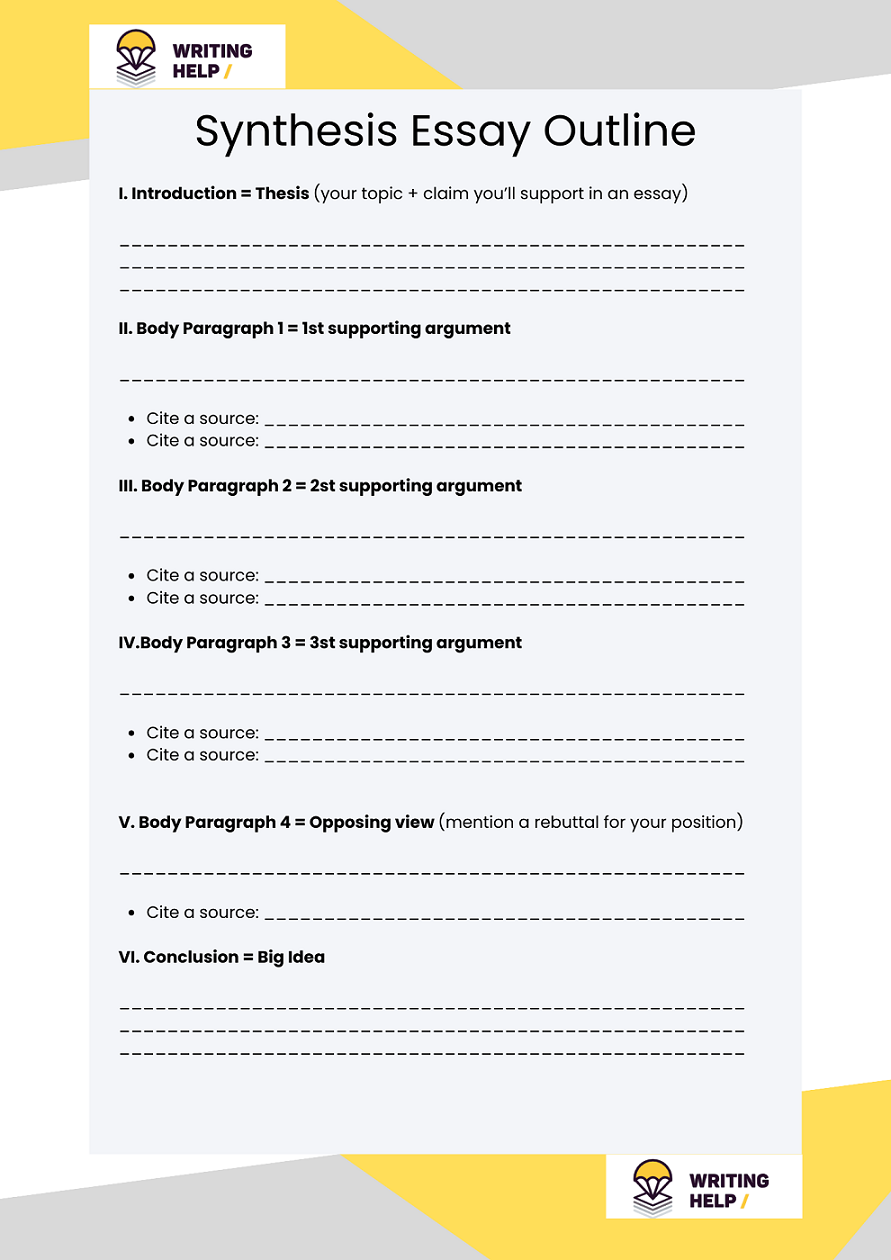
The traditional five-paragraph essay structure can feel restrictive for a synthesis essay. While it's a good starting point, it often doesn’t allow for the complexity of multi-source arguments. Let's explore several outline structures, ranging from linear to more flexible approaches.
Thematic Outline: This structure organizes your essay around key themes or concepts that emerge from your sources. Each section focuses on a specific theme, and you draw on multiple sources to support your analysis. This is a good choice when your sources address a common set of issues from different angles. Example: Introduction, Theme 1 (Sources A, B, C), Theme 2 (Sources B, D, E), Theme 3 (Sources A, C, F), Conclusion.
Argumentative Outline: This structure is similar to a traditional argumentative essay, but with a greater emphasis on synthesizing sources. You present a clear thesis statement and then use evidence from your sources to support your claims. Example: Introduction (Thesis), Argument 1 (Sources A, B), Counterargument 1 (Sources C, D), Argument 2 (Sources B, E), Conclusion.
Networked Outline: This is the most flexible structure, allowing for a more complex and nuanced argument. It doesn’t follow a strict linear progression; instead, it explores the connections between sources in a more organic way. This is a good choice when your sources are highly interconnected and defy easy categorization. It’s harder to pull off, but can be very effective. This might look like a central idea with branching points representing sources and their relationships.
When integrating source material, remember to use transition words and phrases to signal the connections between ideas. Avoid simply dropping in quotes; paraphrase, summarize, and synthesize information to create a cohesive argument. Each outline structure requires careful attention to flow and coherence. Consider how each source contributes to the overall argument and make those connections explicit.
No matter which structure you choose, always start with a strong introduction that clearly states your thesis and provides a roadmap for your essay. And end with a conclusion that summarizes your main points and offers a final perspective on the issue.
Crafting the Thesis: A Synthesis Statement
A synthesis essay thesis is different from a typical argumentative thesis. It’s not just a statement of your position on a topic; it’s a statement about the relationship between your sources. It should articulate the overall argument that emerges from your synthesis of multiple perspectives. Think of it as a mini-summary of your entire essay.
A weak thesis statement might simply state a fact or an opinion: “Social media has a negative impact on society.” A strong thesis statement, on the other hand, acknowledges the complexity of the issue and articulates a nuanced argument: “While social media offers valuable opportunities for connection and communication, its algorithmic biases and echo chambers contribute to political polarization and the spread of misinformation, as demonstrated by the research of [Source A] and the observations of [Source B].
The key is to identify the common thread that runs through your sources. What overarching argument do they support? What new understanding have you gained by bringing them together? Your thesis statement should reflect this synthesis. A good thesis will also hint at the structure of your essay.
Don't be afraid to revise your thesis statement as your understanding of the sources evolves. It’s a fluid process. You might start with a preliminary thesis and then refine it as you continue your research and analysis. It's often the last thing I finalize after finishing the bulk of the writing.
Thesis Statement Check: Evaluating Synthesis Arguments
A strong thesis statement is the foundation of a successful synthesis essay. It doesn't just state your opinion; it articulates a position *formed by* integrating multiple sources. This quiz will test your ability to identify effective synthesis thesis statements. Rate each statement as Poor, Fair, Good, or Excellent based on how well it demonstrates synthesis.
Integrating Evidence: Beyond Quotations
Relying solely on direct quotations can make your essay feel choppy and disjointed. While quotes can be effective, they should be used strategically, not as a substitute for your own analysis. Mastering the art of paraphrasing, summarizing, and synthesizing is crucial for a successful synthesis essay.
Paraphrasing involves restating someone else’s ideas in your own words. It’s important to maintain the original meaning while changing the wording and sentence structure. Summarizing provides a condensed version of a source’s main points. Synthesizing goes a step further, combining information from multiple sources to create a new understanding.
Proper citation is essential to avoid plagiarism. Familiarize yourself with the citation style required by your instructor (MLA or APA are the most common). Use footnotes, endnotes, or in-text citations to give credit to your sources. Purdue OWL is an excellent resource for citation guidelines. Always double-check your citations to ensure accuracy.
Remember, your goal is to use sources to support your argument, not to let them dominate it. Your voice should be the primary one in your essay. Sources are there to provide evidence and support your claims, but they shouldn’t be doing the thinking for you. Think of sources as collaborators, not authorities.
Refining and Revising: The Synthesis Check
Revision is a critical part of the writing process. Don't submit your first draft without carefully reviewing and revising it. A synthesis essay requires a particularly thorough revision, as you need to ensure that your sources are integrated seamlessly and that your argument is coherent and persuasive.
Use this checklist to guide your revision: Is your thesis clear, focused, and arguable? Does your essay have a logical structure? Is the evidence integrated effectively? Are your sources cited correctly? Is your writing clear, concise, and engaging? Have you avoided plagiarism?
It’s also helpful to get feedback from others. Ask a friend, classmate, or writing tutor to read your essay and provide constructive criticism. A fresh pair of eyes can often catch errors or weaknesses that you might have missed. Be open to feedback and willing to make changes.
Finally, read your essay aloud. This can help you identify awkward phrasing, grammatical errors, and areas where the flow is disrupted. A well-revised synthesis essay is a testament to your critical thinking skills and your ability to synthesize information effectively. Take the time to polish your work, and you’ll be well on your way to success.
- Check thesis clarity and focus.
- Evaluate logical structure.
- Assess evidence integration.
- Verify accurate citations.
- Ensure clear and concise writing.
- Seek feedback from others.


No comments yet. Be the first to share your thoughts!