

Book Titles in Essays: The Core Issue
Formatting book titles correctly in your essays might seem like a small detail, but it’s surprisingly important. It’s not simply about adhering to arbitrary rules; it demonstrates a respect for the author’s work and a commitment to academic integrity. Consistent, accurate formatting signals to your reader that you’ve paid attention to detail and taken your research seriously.
The different formatting styles—MLA, APA, and Chicago—developed over time as disciplines established conventions for crediting sources. MLA emerged from the Modern Language Association, initially focused on literature and languages. APA, favored in psychology and the social sciences, prioritizes clarity and recency. Chicago, often used in history and the humanities, offers a more comprehensive and flexible system.
Understanding the why behind these styles is key. They aren’t designed to trip you up, but to create a standardized way to navigate scholarly work. Knowing the origin and purpose of each style will help you not only apply the rules correctly but also understand when and why to use a specific style for your assignment. We will explore each style in detail, outlining the nuances and common pitfalls to avoid.
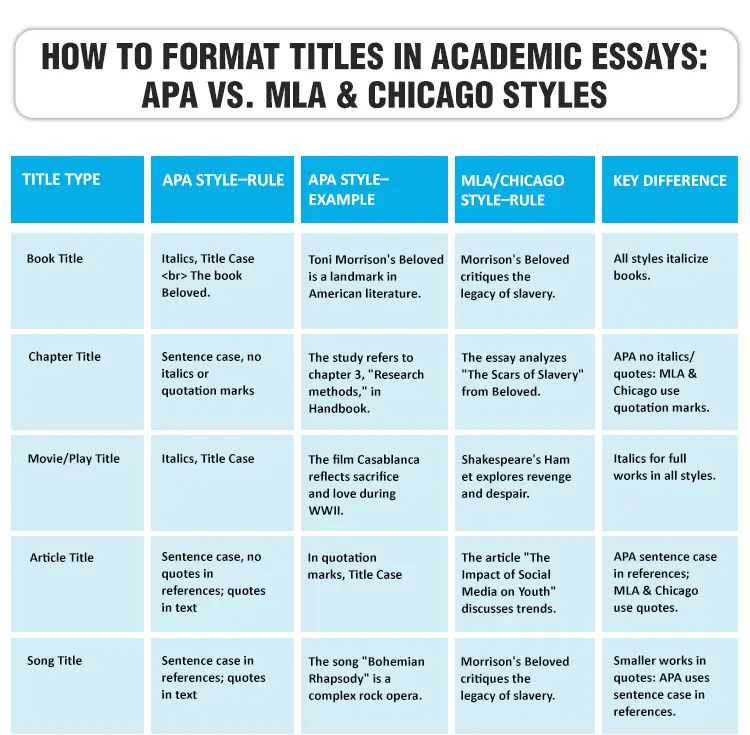
MLA: Italics and Quotation Marks
The MLA Handbook, currently in its 9th edition, offers relatively straightforward guidance on formatting book titles. The core rule is this: italicize the full title of a book. This applies whether you’re mentioning the title in the body of your essay or in your Works Cited list. For example, you would write Pride and Prejudice rather than putting it in quotation marks. It’s a simple rule, but consistency is vital.
However, things get a bit more nuanced when dealing with titles within an essay. If you’re referring to a chapter, short story, poem, or article that’s part of a larger work, use quotation marks. So, while the book Frankenstein is italicized, a chapter titled “The Creature’s Origins” would be enclosed in quotation marks. Think of it as a container within a container—the book is the larger container, and the chapter is inside.
Subtitles are treated as part of the main title and are also italicized. For example, The Lord of the Rings: The Fellowship of the Ring. When a title contains another title within it, the inner title maintains its original formatting. For instance, if you’re discussing a collection of essays titled “The Waste Land” and Its Influence, the poem “The Waste Land” remains in quotation marks while the collection title is italicized.
Here are a few examples to illustrate: I am analyzing themes in To Kill a Mockingbird. The essay focuses on the short story “A Rose for Emily” from Faulkner’s Collected Stories. Chapter 3 of The Hitchhiker’s Guide to the Galaxy* is titled “Mostly Harmless.”
Essential Resources for Mastering Essay Formatting

Comprehensive guide to research methodologies · Covers writing, editing, and publishing practices · Fourth edition, updated for current academic standards
This authoritative guide provides in-depth knowledge on research and writing, essential for understanding the context of citation styles.

Official MLA Handbook · Definitive guide to MLA citation and formatting · Essential for academic writing in the humanities
This official handbook provides the definitive rules for MLA style, ensuring academic accuracy and clarity in essays.

Official Publication Manual of the American Psychological Association · Seventh edition, updated for current standards · Covers APA citation, formatting, and style
This official manual provides the definitive rules for APA style, ensuring academic accuracy and clarity in essays.

The Chicago Manual of Style, 17th Edition · Comprehensive guide to style, usage, and citation · Authoritative resource for academic and professional writing
This authoritative style guide provides the definitive rules for Chicago style, ensuring academic accuracy and clarity in essays.

Visual reference for grammar rules · Uses infographics for clear explanations · Covers essential grammar concepts
This resource offers a clear and accessible way to understand grammar, which is foundational for accurate citation and formatting.
As an Amazon Associate I earn from qualifying purchases. Prices may vary.
APA: Italicizing, But With Exceptions
The American Psychological Association (APA) 7th edition, largely mirrors MLA in its use of italics for book titles. You should italicize the full title of a book when referencing it in your essay. For example, Thinking, Fast and Slow is correctly formatted. However, APA places a strong emphasis on clarity and conciseness, meaning there are a few key differences to keep in mind.
Unlike MLA, APA doesn’t typically use quotation marks for titles of shorter works like chapters or articles within the body of your paper. Instead, these are simply presented as part of your sentence. In the reference list, however, chapter titles are not italicized. This is a common source of confusion for students, so pay close attention to where you’re referencing the title.
APA also provides guidance on handling lengthy or complex titles. If a title is excessively long, you can use an ellipsis (…) to shorten it, but ensure the remaining portion is still recognizable. Avoid over-italicizing; only the book title itself should be in italics, not any surrounding punctuation or introductory phrases. For example, write The Psychology of Human Relationships, not The book, The Psychology of Human Relationships.
In your reference list, the book title should be italicized, followed by the author’s name and publication details. Consider this example: Kahneman, D. (2011). Thinking, fast and slow. Farrar, Straus and Giroux. Notice the placement of the author and year before the italicized title. This contrasts with MLA's author-last-name-first format.
Chicago Manual: A More Flexible System
The Chicago Manual of Style (17th edition) is known for its comprehensive coverage and, importantly, its two main systems: Notes-Bibliography and Author-Date. The formatting of book titles differs slightly between these systems. In the Notes-Bibliography system, book titles are generally italicized, similar to MLA and APA. However, Chicago offers more flexibility—and thus, more room for error.
The Author-Date system, commonly used in the sciences, also generally italicizes book titles, but allows for more variation in how titles are presented in the bibliography versus within the text. The key difference lies in how Chicago handles shorter works. While MLA uses quotation marks for chapters and articles, Chicago often allows you to simply present these titles in plain text, especially in the notes themselves.
Chicago also provides specific guidance for titles in different languages. Titles in languages that don’t use the Roman alphabet (e.g., Cyrillic, Greek) are typically presented in a romanized form (transliterated into the Roman alphabet) and then italicized. This can be complex, so consulting the manual directly is often necessary.
The Chicago Manual also acknowledges that certain circumstances may warrant a deviation from strict italicization. For instance, if a title is frequently mentioned throughout your paper, you might choose to omit italics after the first instance for readability. However, this decision should be made consciously and consistently.
Side-by-Side: A Quick Reference Table
Here’s a quick reference table summarizing the key differences in formatting book titles across MLA, APA, and Chicago styles. This table focuses on the most common scenarios to help you quickly find the rule you need. Remember that these are general guidelines, and consulting the specific style manual is always recommended for complex cases.
Note: 'Title within a title' refers to a situation where you are referencing a work that contains another titled work (e.g., an essay titled "The Significance of X" published in a book).
- Full Book Title: MLA (Italicize), APA (Italicize), Chicago (Italicize – Notes-Bib) / (Italicize – Author-Date)
- Chapter Title: MLA (Quotation Marks), APA (Plain Text in body, not italicized in reference list), Chicago (Plain Text or Quotation Marks – Notes-Bib) / (Plain Text – Author-Date)
- Short Story Title: MLA (Quotation Marks), APA (Plain Text), Chicago (Plain Text or Quotation Marks – Notes-Bib) / (Plain Text – Author-Date)
- Title within a Title: MLA (Inner title in quotation marks, outer title italicized), APA (Follow rules for chapter/short story titles), Chicago (Follow rules for chapter/short story titles)
Formatting Book Titles in Essays: A Style Comparison (2026)
| MLA | APA | Chicago |
|---|---|---|
| Full Book Title | Italicized | Italicized |
| Chapter Title | In quotation marks | In quotation marks |
| Short Story Title | In quotation marks | In quotation marks |
| Title within a Title | Italicize the overall work; put the title within in quotation marks | Italicize the overall work; put the title within in quotation marks |
| Subtitle | Italicized along with the main title | Italicized along with the main title |
Illustrative comparison based on the article research brief. Verify current pricing, limits, and product details in the official docs before relying on it.
Troubleshooting Common Errors
Even with clear guidelines, mistakes happen. A common error is italicizing journal titles – these should not be italicized in any of these styles. Another frequent mistake is using quotation marks for novels or full-length books. Remember, italics are generally reserved for complete works, while quotation marks are for parts of those works.
Inconsistent formatting within a single paper is another issue. Ensure you apply the chosen style consistently throughout your entire essay, including the Works Cited or References page. Pay close attention to the rules regarding subtitles, and don’t forget to italicize titles in both the body of your paper and in your bibliography.
The rise of ebooks and online books raises the question of whether the rules change. The answer is generally no. Whether a book is in print or digital format, the same formatting rules apply. However, if you’re citing a specific edition (e.g., Kindle edition), include that information in your citation.
Finally, what do you do with unusually long titles or titles containing special characters? For excessively long titles, use an ellipsis (…) to shorten them while maintaining clarity. If a title contains characters not typically found in the Roman alphabet, follow the guidelines for transliteration provided in the relevant style manual.
Interactive Style Checker
To help you verify your formatting, Superior Formatting offers an interactive style checker. Simply input the book title and select the style you’re using (MLA, APA, or Chicago), and the tool will output the correctly formatted title. This feature is designed to empower you to confidently format your work and avoid common errors. It’s a quick and easy way to double-check your citations and ensure accuracy.
Beyond the Basics: Uncommon Cases
What about titles in foreign languages? Generally, these should be translated into English if possible, and the translated title should be italicized according to the relevant style guide. If a translation isn’t available or isn’t suitable, you can use the original title, followed by a translation in brackets.
If a book title is also the title of a movie, treat them as separate works. The book title should be formatted according to the guidelines above, and the movie title should be formatted as a film title (typically italicized). Ancient texts present another challenge. Follow the guidelines for classical works provided in the relevant style manual, which may involve using specific abbreviations or formatting conventions.
Style guides don't always have clear answers for every situation. When in doubt, prioritize clarity and consistency. Consult multiple sources, and if you’re still unsure, ask your instructor for guidance. Remember, the goal is to present your work in a professional and scholarly manner.

No comments yet. Be the first to share your thoughts!