

Synthesis is more than summarizing
A synthesis essay is often the first major writing challenge for many students moving beyond high school. It’s easy to mistake it for a glorified research paper or a series of summaries, but that’s a fundamental misunderstanding. A synthesis essay isn’t about reporting what others have said; it’s about constructing a new, original argument from those sources. Think of yourself as a lawyer building a case, using evidence presented by witnesses – your sources – to persuade a jury – your reader.
This type of essay is particularly common in AP Language and Composition, and increasingly in introductory college courses. These assignments aren’t trying to trick you, but rather to assess your ability to think critically and engage with complex ideas. Mastering the synthesis essay isn’t just about getting a good grade; it’s about developing a skill that will serve you well in any field that requires analysis, problem-solving, and persuasive communication.
The core difference lies in the argument. A simple summary just restates existing information. A synthesis essay takes multiple sources and combines them to create something new. It’s about identifying patterns, contradictions, and nuances across different perspectives. It’s about building something larger than the sum of its parts. I've found that students who struggle most often focus too much on accurately representing each source individually, and not enough on how those sources work together to support a central claim.
It’s about making connections, drawing inferences, and ultimately, presenting a well-supported and insightful argument. Don’t aim to simply show you’ve read the sources; aim to show you’ve thought about them, and can use them to make a compelling point. This requires a shift in mindset – from information gatherer to critical analyst.
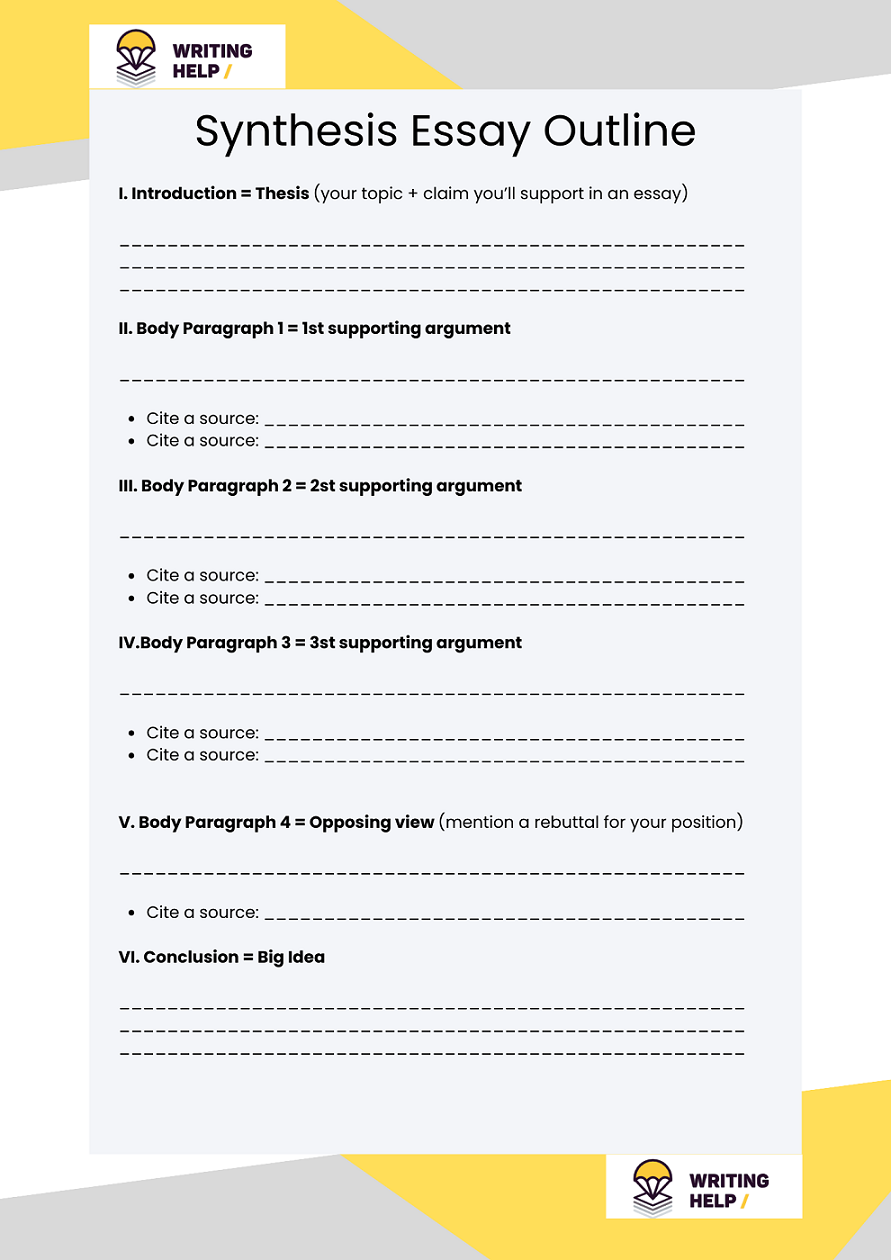
Pick a side in the prompt
The first, and often most overlooked, step in writing a successful synthesis essay is carefully deconstructing the prompt. Students often rush into research before fully understanding what’s being asked of them. I’ve seen too many essays that miss the mark simply because they didn’t address the core question. Start by identifying the keywords – the terms that define the scope of the discussion.
Pay attention to the verbs used in the prompt. Are you being asked to analyze, evaluate, compare, contrast, or argue? The verb dictates the type of argument you’ll need to construct. Avoid the temptation to simply restate the prompt as your thesis. That demonstrates understanding, but it doesn’t demonstrate thinking. A good thesis is an assertion – a claim that needs to be proven.
I use a method I call the "So What?’ test. Once you’ve drafted a potential thesis statement, ask yourself: ‘So what?’ Why does this argument matter? What are the implications? If your potential thesis doesn’t answer the ‘So What?’ question, it"s probably not strong enough. Let's look at an example: A prompt asks, 'To what extent did social media influence the 2020 US Presidential Election?' A weak thesis: 'Social media influenced the 2020 election.' A stronger thesis: 'While not solely determinative, social media significantly amplified existing political polarization during the 2020 election, ultimately impacting voter turnout among young adults.'
Past AP Lang prompts often center around complex societal issues. For example, the 2023 exam prompt asked students to synthesize information about the influence of technology on human relationships. A strong response required not just identifying how technology impacts relationships, but also evaluating the nature and extent of that impact.
Synthesis Essay Thesis Statement Challenge
Welcome! This quiz will test your ability to craft strong thesis statements for synthesis essays. A successful synthesis essay doesn't just *report* on sources; it argues a point *using* those sources. Each question presents a prompt and four potential thesis statements. Select the statement that best exemplifies a strong, arguable thesis for a synthesis essay. Remember, a strong thesis goes beyond stating the obvious and offers a specific perspective.
Pick sources that actually matter
I’m a firm believer that fewer, well-chosen sources are better than a large number of superficial ones. Many students fall into the trap of thinking they need to include as many sources as possible to demonstrate thorough research. This often leads to a cluttered and unfocused essay. Prioritize quality over quantity. You want sources that are relevant, credible, and offer diverse perspectives.
When evaluating sources, consider the author’s credentials and potential biases. Is the author an expert in the field? What is their affiliation? Do they have a vested interest in the topic? Websites like Snopes and PolitiFact can be helpful for fact-checking. A quick Google Scholar search can reveal how often a source has been cited by other researchers, which is a good indicator of its influence and credibility. Be wary of sources that lack clear authorship or rely heavily on anecdotal evidence.
Don’t fall into the echo chamber. Seek out sources that challenge your own assumptions and offer alternative viewpoints. This demonstrates intellectual honesty and strengthens your argument. Acknowledging opposing perspectives is a sign of critical thinking, not weakness. If all your sources agree with each other, you’re likely missing a crucial part of the story.
Handling conflicting information is also key. Sources will inevitably disagree. Instead of ignoring these discrepancies, address them directly. Explain why one source might be more credible than another, or acknowledge the limitations of each perspective. This shows that you’ve engaged with the material in a thoughtful and nuanced way.
Ways to organize your thoughts
Now that you’ve selected your sources, it’s time to build your argument. There are several common organizational patterns for synthesis essays, each with its own strengths and weaknesses. The best pattern will depend on the specific prompt and the nature of your sources. One common approach is point-by-point, where you address each point of your argument and support it with evidence from multiple sources. This can be effective for demonstrating a clear and focused line of reasoning.
Another option is source-by-source, where you dedicate a section of your essay to each source, explaining how it contributes to your overall argument. This can be useful for analyzing the nuances of each source, but it can also lead to a disjointed and repetitive essay if not handled carefully. A thematic approach organizes your essay around central themes or concepts, drawing on evidence from multiple sources to support each theme. This is often the most sophisticated approach, but it requires a strong understanding of the material.
Whatever structure you pick, you need clear transitions. Use words like 'similarly' or 'however' to show how ideas connect. I've seen too many essays jump from one topic to another without warning. Every paragraph needs to start with a sentence that ties back to your main point so the reader doesn't get lost.
Consider the audience. An AP Lang reader will be looking for a sophisticated argument, well-supported evidence, and clear writing. A college admissions officer might be more interested in your ability to think critically and demonstrate intellectual curiosity. Tailor your organizational pattern and writing style to your audience. A strong structure is not simply about following a formula; it's about making your argument as clear and persuasive as possible.
Synthesis Essay Organizational Patterns: A Comparative Overview (2026)
| Organizational Pattern | Complexity | Clarity for Reader | Prompt Suitability | Potential Drawbacks |
|---|---|---|---|---|
| Point-by-Point | Moderate | Can be very clear if executed well, facilitating direct comparison. | Best suited for prompts asking for direct comparison of sources regarding specific points or arguments. | May become repetitive if points are limited or sources offer little contrasting information. |
| Source-by-Source | Lower | Generally easier to follow as it dedicates sections to individual sources. | Effective for prompts requiring detailed analysis of each source *before* synthesis. | Can hinder the development of a cohesive argument if transitions between source discussions are weak. |
| Thematic | High | Offers the potential for a nuanced and sophisticated argument, demonstrating insightful connections. | Ideal for prompts that focus on broad themes or concepts explored across multiple sources. | Requires strong analytical skills to identify and articulate overarching themes; can become unfocused if themes are poorly defined. |
| Point-by-Point (Modified) | Moderate to High | Can maintain clarity while allowing for more in-depth discussion of each source’s contribution to a specific point. | Useful when prompts require both comparison *and* detailed source analysis. | Risks losing thematic coherence if not carefully structured. |
| Source-by-Source (Integrated) | Moderate to High | Attempts to synthesize within each source section, lessening the drawback of fragmentation. | Suitable for prompts where understanding the individual source’s context is crucial before drawing broader conclusions. | Still requires skillful transitions to avoid a disjointed feel. |
| Thematic (with Source Integration) | Very High | Demonstrates the highest level of analytical thinking by weaving source material seamlessly into thematic discussions. | Best for complex prompts demanding a highly original and insightful synthesis. | Most challenging to execute effectively; requires extensive planning and revision. |
Illustrative comparison based on the article research brief. Verify current pricing, limits, and product details in the official docs before relying on it.
Blending sources into your prose
Seamlessly integrating source material is arguably the most challenging aspect of writing a synthesis essay. Simply dropping quotes into your essay isn't enough – you need to explain how those quotes support your argument. There are several methods for incorporating source material: quoting, paraphrasing, and summarizing. Each has its own purpose and limitations.
Quoting is best used for particularly impactful or well-phrased statements. Paraphrasing allows you to rephrase a source’s ideas in your own words, which can be useful for simplifying complex concepts or avoiding overly long quotes. Summarizing condenses a larger passage into a concise overview. Proper citation is crucial, whether you’re using MLA or APA format. Failure to cite your sources constitutes plagiarism, which can have serious consequences.
Don't 'quote bomb' by stringing sentences together without explaining them. Quotes should back up your claims, not replace them. Give the quote some context and then explain why it matters. If you just drop a quote in, you're letting the source do your job. Instead of just saying Smith thinks social media is powerful, explain that Smith (2023) sees it as a tool for shaping public opinion.
Ethical considerations are paramount. Always give credit where credit is due, and avoid misrepresenting a source’s ideas. Be mindful of potential biases and acknowledge any limitations in your own interpretation. Remember, the goal is not just to present information, but to engage with it critically and responsibly.
Handling the gray areas
A truly strong synthesis essay doesn’t shy away from complexity. It acknowledges counterarguments and demonstrates a nuanced understanding of the issue. Ignoring opposing viewpoints weakens your argument and suggests a lack of critical thinking. Addressing counterarguments shows that you’ve considered multiple perspectives and have a reasoned basis for your own position.
Techniques for conceding points to opposing viewpoints include acknowledging the validity of certain claims, but then explaining why those claims don’t undermine your overall thesis. For example, you might acknowledge that social media can foster positive connections, but then argue that its negative effects on mental health outweigh those benefits. This demonstrates intellectual honesty and strengthens your credibility.
It's important to demonstrate that you understand the limitations of your own argument. No argument is perfect, and acknowledging weaknesses can actually enhance your persuasiveness. This shows that you’ve thought critically about the issue and are willing to admit when your own reasoning is incomplete. Avoid absolute statements and overly broad generalizations.
This is where an essay moves from good to truly insightful. It's about recognizing the gray areas and embracing the complexities of the issue. A nuanced argument is more persuasive and more likely to resonate with your reader. Don't be afraid to challenge your own assumptions and explore alternative perspectives.
Synthesis Essays in 2026: Emerging Trends
Looking ahead to 2026, several trends are likely to shape the future of synthesis essay assignments. I anticipate a greater emphasis on digital literacy and the ability to evaluate sources from diverse online platforms. Students will need to be able to critically assess the credibility and bias of websites, social media posts, and other online content.
We might also see more prompts that require students to synthesize information from multimedia sources – videos, podcasts, infographics, and interactive simulations. This will challenge students to integrate different modes of communication and think critically about visual and auditory information. The increasing prevalence of AI-assisted writing tools also presents new challenges and opportunities.
While AI can be a helpful tool for brainstorming and research, it’s crucial to use it responsibly and ethically. Students will need to be able to distinguish between their own original ideas and content generated by AI. Plagiarism detection software is becoming increasingly sophisticated, and educators will be vigilant in identifying instances of academic dishonesty.
Ultimately, the core skills required for writing a successful synthesis essay – critical thinking, argumentation, and effective communication – will remain essential. However, the context in which those skills are applied will continue to evolve, requiring students to be adaptable, resourceful, and digitally literate.
Common Synthesis Essay Errors
- Weak Thesis - A synthesis essay requires a thesis that doesn't simply report on sources, but argues a position *based* on them. Ensure your thesis is debatable and offers a unique insight.
- Insufficient Evidence - Relying on too few sources, or using sources superficially, weakens your argument. A robust synthesis draws on a diverse range of perspectives.
- Poor Source Integration - ‘Dropping’ quotes without context or explanation disrupts the flow and fails to demonstrate understanding. Use signal phrases and explain the relevance of each source.
- Logical Fallacies - Errors in reasoning, such as ad hominem attacks or straw man arguments, undermine your credibility. Carefully review your logic before submission.
- Lack of Analysis - Simply summarizing sources isn’t synthesis. You must critically analyze them, identifying connections, contradictions, and patterns.
- Formatting Errors - Incorrect citations (MLA, APA, Chicago) or inconsistent formatting distracts readers and can impact your grade. Consult style guides like the MLA Handbook or the Publication Manual of the American Psychological Association.
- Plagiarism - Presenting someone else’s work as your own, even unintentionally, is a serious academic offense. Always properly cite your sources, and utilize plagiarism checkers like Turnitin.
No comments yet. Be the first to share your thoughts!